From model calls to governed systems that can plan, act, recover, and prove their work
The central mistake in many AI projects is treating an agent as a prompt wrapped around a language model.
That approach is enough for a demo. It is not enough for production.
A production agent must understand a business outcome, choose the right model and tools, operate inside a controlled environment, recover from failure, request approval at the right moment, and leave behind evidence of what it did.
In 2026, the competitive advantage is moving up the stack. The question is no longer simply, “Which model is smartest?” It is:
Can this system complete a valuable task reliably, at an acceptable cost, with the right data boundaries and enough evidence for a human or an auditor to trust it?
This article uses “production” narrowly. An agent is production-ready when its behavior is bounded, its side effects are governed, its failures are recoverable, and its results can be measured over time. A polished chat demo can be useful without meeting any of those conditions.
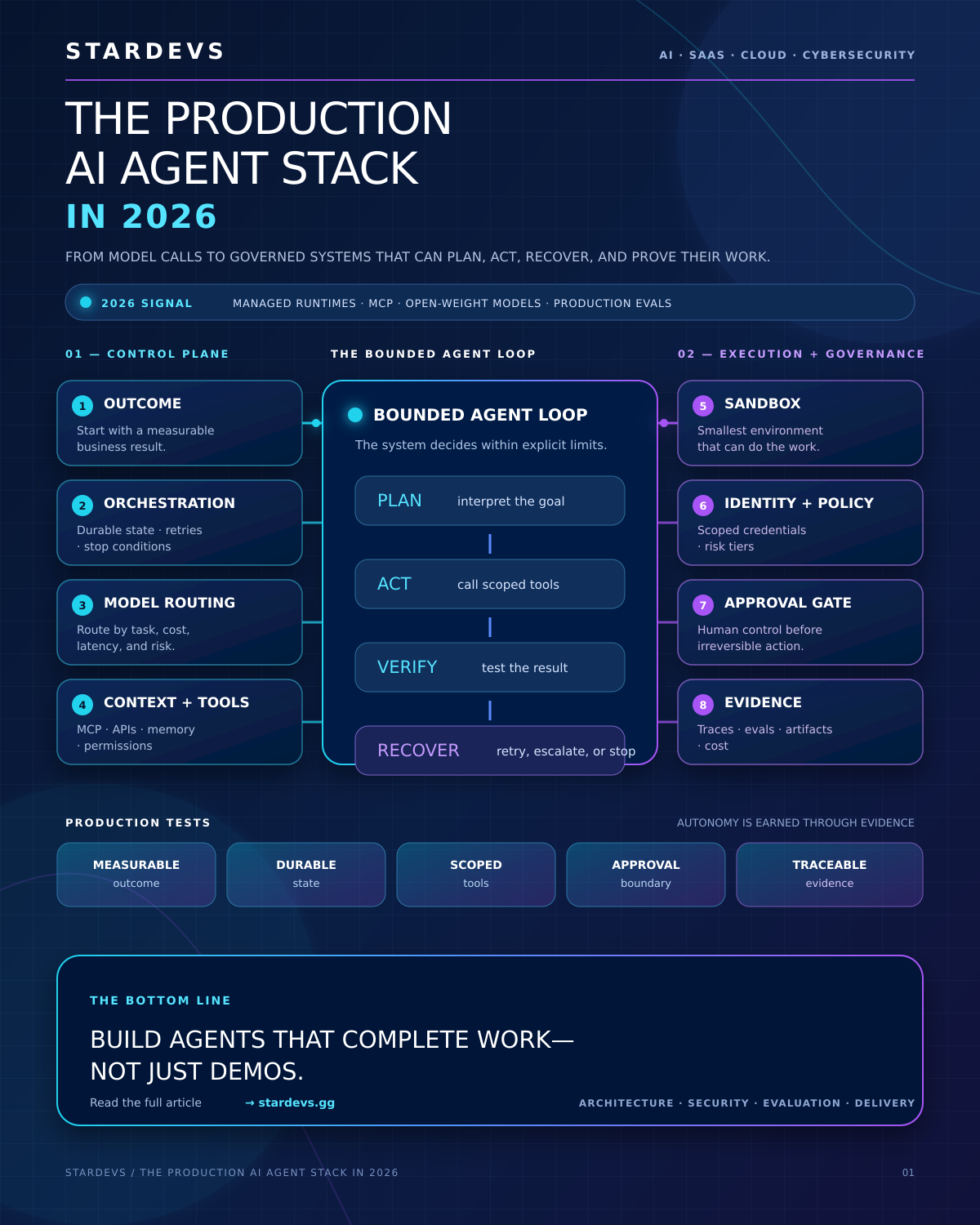
The stack at a glance#
The layers are coupled, but they should not be confused. MCP can standardize tool access; it does not replace authorization. A sandbox limits execution; it does not tell you whether the agent produced the correct result. A better model can reduce errors; it does not create an operating policy.
The control plane and the execution plane#
The most useful architectural distinction is between deciding and acting:
| Plane | Owns | Production question |
|---|---|---|
| Control plane | Goal, state, model routing, budgets, policy, approvals, retries | Can the run be paused, resumed, explained, and stopped? |
| Execution plane | Sandboxes, APIs, files, databases, browsers, and business systems | Can every action be limited, observed, and reversed where necessary? |
| Evidence plane | Traces, artifacts, evaluator scores, audit records, and cost data | Can the team prove what happened and improve the workflow? |
The model participates in the control plane. It is not the security boundary. The system must enforce permissions, network access, and approval rules outside the model-generated text.
What changed in 2026#
The leading AI companies are converging on the same architectural direction: agents are becoming runtimes and packaged workflows, not just model endpoints.
OpenAI’s updated Agents SDK provides a model-native harness for long-running work, native sandbox execution, configurable memory, and the ability to externalize state so a run can be snapshotted, rehydrated, and resumed after a sandbox failure. Developers can also bring their own sandbox provider. OpenAI Agents SDK
Anthropic is packaging domain work as deployable agent systems. Its financial-services release combines skills, governed connectors, subagents, long-running sessions, per-tool permissions, managed credentials, and audit logs. The important product is the workflow and its controls, not the model in isolation. Anthropic financial-services agents
The Model Context Protocol has also moved beyond basic tool discovery. The 2026-07-28 specification adds a stateless protocol core, Tasks for long-running work, MCP Apps for interactive interfaces, stronger authorization alignment, and a formal deprecation policy. Because the release introduced breaking changes, production teams should pin compatible SDK versions and test remote servers before upgrading. MCP 2026-07-28 specification
Chinese and open-weight providers are part of the same shift. DeepSeek’s V4 Preview was released with an explicit agentic-coding focus; Alibaba’s Qwen Code is a terminal agent connected to Model Studio; Z.ai presents a GLM-5.3 harness and AutoGLM for reasoning, tool use, and execution; and MiniMax M3 combines open weights, long context, multimodality, and desktop control. DeepSeek V4 Preview · Qwen Code · Z.ai · MiniMax M3
| Ecosystem signal | What it changes in a production stack |
|---|---|
| Managed agent runtimes | Less custom harness code, but more attention to data boundaries, portability, and vendor-specific behavior |
| Domain-specific agent templates | Faster time to value when skills, connectors, approvals, and evidence are packaged together |
| MCP’s evolving protocol | A more standard connector layer, but also a need for version pinning, server trust, and compatibility testing |
| Chinese and open-weight agent models | More options for cost, latency, multilingual work, data residency, and private deployment—but more responsibility for evaluation and operations |
The practical conclusion is not that one vendor has won. It is that model choice, agent harness, connector layer, and execution environment are now separable architectural decisions.
Layer 1: Start with an outcome, not a model#
The system should begin with a measurable business outcome:
- Resolve a customer issue within ten minutes.
- Produce a reviewed pull request that passes the test suite.
- Reconcile a defined set of accounts.
- Research a market and deliver a cited decision brief.
- Detect and triage a production incident.
An agent should not be evaluated by whether it generated an impressive answer. It should be evaluated by whether it moved the business process forward without creating unacceptable risk.
This changes product design. The main screen is not necessarily a chat window. It may be a work queue, an approval inbox, a run history, a research workspace, or a dashboard of unresolved exceptions.
Before writing the system prompt, write a task contract:
- Inputs and data sources the run may use.
- Actions the agent may take and actions it must never take.
- The acceptance test for a successful result.
- The maximum time, tool calls, spend, and retries.
- The condition that requires escalation or a conventional fallback.
This contract becomes the basis for the workflow, policy rules, evaluation cases, and user interface. It is more durable than a prompt and easier to review with a business owner.
Layer 2: Orchestration and durable state#
The orchestration layer controls the agent loop:
- Interpret the goal.
- Build a plan.
- Select tools and models.
- Execute a bounded step.
- Check the result.
- Continue, retry, escalate, or stop.
The key word is durable. A production run may last minutes, hours, or days. It may encounter a rate limit, a failed tool, a lost container, a human delay, or a context-window limit. The system must be able to resume from a checkpoint rather than restarting from the beginning.
Use an explicit state machine or workflow graph for important processes. An unconstrained loop is difficult to test, budget, secure, and explain.
Persist the state that another process needs to resume the work: the task contract, current step, tool-call identifiers, approvals, artifacts, retry budget, and last known environment. Do not treat the model’s conversation transcript as the workflow database.
For most businesses, the first production agent should be a bounded workflow with clear stop conditions—not an autonomous general-purpose employee.
That is consistent with production research. A study of 20 case studies and 86 deployed-systems practitioners across 26 domains found that 68% of production agents executed ten or fewer steps before human intervention, 70% relied on prompting off-the-shelf models rather than weight tuning, and 74% depended primarily on human evaluation. Reliability was the top development challenge. Measuring Agents in Production
Layer 3: Model routing and reasoning#
There is no reason to use the most expensive model for every step.
A practical model router can assign work by task:
| Task | Typical model profile |
|---|---|
| Classification, extraction, and routing | Fast, low-cost model |
| Planning and ambiguous reasoning | Frontier reasoning model |
| Code generation and repository changes | Coding-optimized model |
| Images, video, audio, or documents | Native multimodal model |
| Sensitive or high-volume workloads | Approved private or open-weight model |
| Verification and critique | Independent judge or rule-based evaluator |
The router should consider more than model quality. It should also consider latency, cost, context length, data residency, tool compatibility, and failure history.
The important metric is not tokens consumed. It is cost per successfully completed task.
Keep model access behind an adapter or gateway. Normalize structured outputs, tool-call formats, context limits, retries, safety refusals, and usage accounting there. This is what makes it possible to compare OpenAI, Anthropic, DeepSeek, Qwen, GLM, MiniMax, and private models on the same workflow rather than comparing marketing claims.
Choose the deployment pattern deliberately
There are four reasonable starting points. The right choice depends on data sensitivity, operational capability, and how much control the workflow needs.
| Pattern | Best for | Main trade-off |
|---|---|---|
| Managed agent API | Fast pilots and standard workflows | Fastest path, but the provider controls more of the runtime and data path |
| Framework plus your own control plane | Teams with strong platform engineering | Maximum flexibility, with more work for durability, sandboxing, and operations |
| Hybrid model gateway | Most enterprise applications | Keeps policy and evidence in your environment while routing work across approved providers |
| Private or open-weight deployment | Sensitive, high-volume, multilingual, or residency-bound workloads | More control and potentially lower unit cost, but GPU operations, licensing, and model evaluation become your responsibility |
For a new business workflow, the hybrid pattern is often the most durable default: own the task contract, state, policy, approval, tool gateway, and evidence; keep model execution replaceable. Move more computation into a private environment only when the data, economics, or latency profile justifies the operational cost.
Layer 4: Context, memory, and tools#
An agent becomes useful when it can access the right context and act on external systems.
This layer normally includes:
- Document and knowledge retrieval.
- Structured databases and business records.
- Files and artifacts.
- APIs and internal services.
- Browsing or search.
- Code execution.
- Tool schemas and permissions.
- Short-term run state.
- Long-term user or organizational memory.
MCP is useful because it creates a common interface between agents and tools. But an MCP server should be treated like a production integration, not a trusted plugin. Validate its identity, restrict its permissions, version its schemas, monitor its calls, and review its data handling.
Do not put every tool definition into every context window. Use a registry, search, or capability negotiation to expose only the tools relevant to the current task. A tool contract should state its input schema, authorization scope, side effects, idempotency behavior, timeout, error format, data classification, and audit fields. A short, precise tool list is usually more reliable than a large catalog.
Treat retrieved documents, web pages, emails, tickets, and tool results as untrusted data. They may contain instructions aimed at the agent. Keep content separate from policy, validate high-impact parameters outside the model, and require approval before an untrusted source can cause an irreversible side effect.
Memory also needs a precise definition. Conversation history, retrieved knowledge, durable user preferences, workflow state, and audit records are different data types. Mixing them into one undifferentiated memory store makes privacy, deletion, debugging, and evaluation harder.
Layer 5: Execution sandbox#
The execution layer is where an agent reads files, runs code, changes a repository, accesses a browser, or interacts with business systems.
A production sandbox should define:
- Which files the agent can read and write.
- Whether it can access the network.
- Which domains and APIs are allowed.
- Which packages or binaries may run.
- CPU, memory, storage, and time limits.
- Whether credentials are available and for how long.
- How the workspace is reset after the run.
- How artifacts are returned and reviewed.
For actions that change external state, add controls above the sandbox:
- Dry-run or preview mode before the first write.
- Idempotency keys so retries cannot duplicate a refund, deployment, or message.
- Transaction boundaries and compensating actions where rollback is possible.
- An egress proxy or allowlist for network access.
- A kill switch that can revoke the run’s capabilities immediately.
OpenAI’s security guidance describes sandboxing and approvals as complementary controls: the sandbox defines the technical boundary, while approval policy determines when the agent must stop and ask. Running Codex safely
The rule should be simple: give the agent the smallest environment in which it can complete the task.
Layer 6: Identity, policy, and human approval#
The agent should never inherit more authority than the user and the workflow require.
Use separate identities for:
- The end user.
- The agent run.
- The tool or connector.
- The execution environment.
- The service account that performs a business action.
High-risk actions should require explicit approval. Examples include sending an external message, publishing code, changing production data, issuing a refund, modifying permissions, or spending money.
Approval should be attached to a specific action and show the user enough context to make a decision:
- What the agent wants to do.
- Which system and records will be affected.
- What data will leave the current boundary.
- What the estimated cost is.
- Whether the action can be reversed.
“Human in the loop” is not a sufficient design. The approval must occur at the right boundary, before the irreversible action—not after the agent has already caused the side effect.
Use risk tiers instead of one global approval switch:
| Risk tier | Example | Default control |
|---|---|---|
| Read-only | Search a knowledge base or inspect logs | Automatic within the user’s data scope |
| Reversible write | Open a draft pull request or create a ticket | Automatic with trace and review |
| High-impact write | Deploy, refund, publish, or change permissions | Explicit approval with a preview |
| Irreversible or regulated | Delete records, move money, or export restricted data | Dual control, stronger authentication, or a human-owned process |
The policy engine should evaluate the actor, target system, data sensitivity, action, amount, and current workflow state. A user’s permission to view a record should not automatically become an agent’s permission to modify it.
Layer 7: Observability and evaluation#
Traditional application monitoring is not enough. An agent can return HTTP 200 and still make a bad decision.
Capture traces that show:
- The original goal and policy context.
- Model and prompt versions.
- Retrieved documents and tool definitions.
- Tool calls and returned data.
- State transitions and retries.
- Token usage, latency, and cost.
- Approval requests and decisions.
- Final artifacts and evaluator results.
The evaluation suite should test the complete workflow, not only the model’s final text. Useful metrics include:
- Task completion rate.
- Correctness of the final artifact.
- Tool-call accuracy.
- Unauthorized-action rate.
- Escalation rate.
- Time to completion.
- Cost per successful task.
- Human review time.
- Recovery rate after tool or environment failure.
Evaluate at four levels:
- Component tests for schemas, permissions, retrieval, and tool errors.
- Scenario tests for complete business tasks with a known acceptance test.
- Adversarial tests for prompt injection, data leakage, tool misuse, and duplicate side effects.
- Production monitoring for drift, escalation, cost, latency, and changes in human review burden.
The trace should preserve the evidence needed to audit a run—inputs, tool calls, state transitions, approvals, outputs, and evaluator results. It does not need to expose or retain private chain-of-thought. Store only what the product, security, and compliance teams can justify retaining.
OpenAI’s evaluation APIs support datasets, graders, score-based evaluation, and repeated runs across models. That reflects an important shift: evaluation is becoming part of the application lifecycle rather than a one-time benchmark exercise. OpenAI Evals
Layer 8: The user experience of controlled autonomy#
Users do not need to see every internal reasoning step. They do need to understand the state of the work.
A good agent interface shows:
- The objective it is pursuing.
- The current phase.
- The systems it is using.
- What it has completed.
- What is blocked.
- What needs approval.
- What evidence supports the result.
- How to pause, retry, revise, or roll back.
Stream structured events rather than only tokens: run started, plan updated, tool requested, approval needed, artifact created, verification passed, retry scheduled, and run completed. This gives the interface a reliable state model and lets the same events power notifications, audit views, analytics, and replay.
For business users, the best experience is often a combination of chat, structured forms, work queues, previews, and approval controls. Chat is the entry point; it should not be the entire product.
A reference implementation for software and cloud teams#
For a software, SaaS, DevOps, or cybersecurity workflow, a sensible default stack looks like this:
| Component | Production default | Why it matters |
|---|---|---|
| Product surface | Streaming run timeline, work queue, approval inbox, and artifact viewer | Users can understand progress without seeing internal reasoning |
| Orchestrator | Durable state machine with checkpoints, retry budgets, and timeouts | Runs survive failures and remain explainable |
| Model gateway | Vendor-neutral adapters, routing, caching, and usage ledger | Models can be compared and replaced without rewriting the workflow |
| Tool gateway | Versioned MCP and native API connectors with typed errors | Tool access is discoverable, testable, and permissioned |
| Execution | Ephemeral per-run sandbox with controlled egress | Code and files are useful without becoming an unrestricted foothold |
| Policy layer | Capability tokens, risk tiers, approval rules, and credential broker | Authority is scoped to the task and the current user |
| Evidence layer | Traces, artifacts, eval runs, audit records, and cost metrics | The team can prove value, investigate failures, and improve the system |
Consider an incident-response agent. It can read telemetry and tickets, form a hypothesis, reproduce the issue in a sandbox, prepare a remediation, and run automated checks. It should stop before production change, show the proposed diff and blast radius, wait for approval, deploy through the normal change path, verify the canary, and roll back or escalate if the acceptance test fails. The value is the controlled workflow—not a claim that the agent is “autonomous.”
A practical maturity model#
| Stage | Capability | Evidence required before moving on |
|---|---|---|
| Prototype | Read-only assistance with a human driving every action | Useful output and a defined task contract |
| Pilot | One bounded workflow, limited writes, sandbox, and approval gates | Scenario tests, traces, and acceptable review time |
| Production | Durable runs, model routing, failure recovery, SLOs, and rollback | Stable task-success rate, cost per successful task, and incident runbook |
| Portfolio | Multiple workflows sharing policy, connectors, evidence, and model infrastructure | Cross-workflow governance, budget controls, drift monitoring, and ownership |
This sequence keeps autonomy proportional to evidence. A team should earn more delegated authority by demonstrating reliability, not by turning on a more permissive agent mode.
What not to do#
Do not start with a multi-agent system
First make one agent reliable. Add subagents only when parallelism, specialization, or isolation creates a measurable benefit.
Do not give agents unrestricted credentials
Use scoped tokens, short-lived credentials, allowlists, and explicit approval for high-impact actions.
Do not call retrieval “memory”
Define what is remembered, why it is retained, who can access it, and how it can be deleted.
Do not optimize only for model quality
A slightly weaker model with better tool contracts, caching, retries, and verification may produce a better business result.
Do not measure only the final answer
Measure the path: wrong tool calls, unnecessary loops, unsafe actions, failed retries, and review burden.
A practical production-readiness checklist#
Before deploying an agent, ask:
- Is the business outcome measurable?
- Is there a written task contract with an acceptance test and risk tier?
- Is the workflow bounded?
- Can the run resume after failure?
- Are tools typed, versioned, and permissioned?
- Are side effects idempotent, previewable, and bounded by transaction or rollback controls?
- Is the execution environment isolated?
- Are credentials scoped and short-lived?
- Are irreversible actions gated by approval?
- Can a kill switch revoke the run’s capabilities?
- Can every run be traced and replayed?
- Do evaluations cover realistic failures and adversarial inputs?
- Can we compare models on the same workflow through a stable adapter?
- Do we know the cost per successful task?
- Is data retention, deletion, and residency defined for context, memory, artifacts, and traces?
- Is there a safe fallback to a human or a conventional workflow?
If the answer to several of these questions is “no,” the system is still a prototype, regardless of how impressive the demo looks.
Conclusion#
The production AI agent stack in 2026 is not a single framework. It is a controlled operating system for delegated work.
The model provides intelligence, but the surrounding system provides reliability:
- Orchestration gives the agent a durable process.
- Tools and context connect it to reality.
- Sandboxes limit its reach.
- Identity and approvals control authority.
- Observability explains what happened.
- Evaluations show whether it worked.
- The user experience makes autonomy understandable.
The 2026 model race matters because it gives builders more choices. OpenAI and Anthropic are productizing managed runtimes and domain workflows, while Chinese and open-weight ecosystems are pushing down cost, expanding deployment options, and shipping capable coding and multimodal agents. That makes vendor lock-in less defensible—but it makes evaluation, policy, and portability more important.
The teams that win will not be the ones that simply connect the newest model to the largest number of tools. They will be the ones that can prove their agents create value safely, repeatedly, and at a cost the business can defend.
For StarDevs, that is the practical opportunity: build model-agnostic agent systems around real software, SaaS, cloud, DevOps, and cybersecurity workflows—and measure the completed work, not the demo.
Research notes#
- OpenAI: Introducing the Agents API
- OpenAI: The next evolution of the Agents SDK
- OpenAI: Running Codex safely
- Anthropic: Agents for financial services
- Model Context Protocol: 2026-07-28 specification
- DeepSeek V4 Preview
- Alibaba Cloud: Qwen Code
- Z.ai
- MiniMax M3
- Measuring Agents in Production